

How a Car Engine Works – a Complete Guide From Start to End
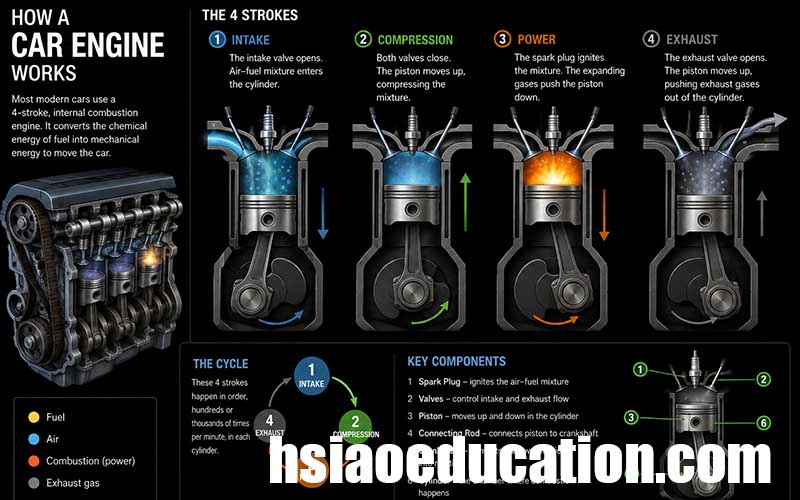
A car engine is one of the most important and fascinating parts of a vehicle. It converts the chemical energy stored in fuel into mechanical energy that ultimately turns the wheels. Although modern engines contain hundreds of individual parts, the basic idea behind how they work is relatively simple: fuel and air are burned in a controlled process, the resulting pressure pushes mechanical components, and that movement is transferred to the wheels.
Most cars use an internal combustion engine, meaning that fuel is burned inside the engine itself. The most common type is the four-stroke petrol engine, although diesel engines and newer hybrid and electric powertrains work differently. Understanding the four-stroke cycle provides a useful foundation for understanding how most traditional car engines operate.
The Main Parts of an Engine
Before looking at the process, it is helpful to understand some of the engine’s major components. The engine block is the main structure of the engine and contains the cylinders. Inside each cylinder is a piston, which moves up and down. The piston is connected to a connecting rod, which links it to the crankshaft.
The crankshaft converts the pistons’ up-and-down movement into rotational movement. This rotation is eventually transmitted through the transmission, driveshafts or axles, and finally to the wheels.
Above the cylinders is the cylinder head, which contains the intake and exhaust valves. In a petrol engine, spark plugs ignite the air-fuel mixture. The engine also has systems for supplying fuel, controlling air, removing exhaust gases, lubricating moving parts, and keeping temperatures under control.
The Four-Stroke Cycle
A typical four-stroke petrol engine completes its basic operating cycle in four stages: intake, compression, power, and exhaust. These four strokes happen repeatedly while the engine is running.
1. Intake Stroke
The first stage is the intake stroke. As the piston moves downward inside the cylinder, the intake valve opens. This creates a pressure difference that allows air and fuel to enter the cylinder.
In modern engines, the amount of fuel and air is carefully controlled by electronic systems. A device called the engine control unit (ECU) receives information from various sensors and determines how much fuel should be injected and when it should be injected.
Once the piston reaches the bottom of the cylinder, the intake valve closes. The cylinder now contains a carefully prepared mixture of air and fuel.
2. Compression Stroke
During the second stage, the piston moves upward while both the intake and exhaust valves remain closed. The piston compresses the air-fuel mixture into a much smaller space.
Compression is important because it increases the pressure and temperature of the mixture, allowing it to release energy more effectively when ignited. The engine’s compression ratio describes how much the mixture is compressed.
Near the top of the compression stroke, the spark plug produces an electrical spark. This spark ignites the compressed mixture. In a diesel engine, there is no conventional spark plug for ignition; instead, air is compressed to such a high temperature that injected diesel fuel ignites.
3. Power Stroke
The third stage is the power stroke, and it is where the engine produces useful mechanical energy.
When the spark ignites the mixture, combustion occurs extremely rapidly. The expanding gases create high pressure inside the cylinder and force the piston downward. The piston pushes on the connecting rod, which turns the crankshaft.
The crankshaft’s rotation is the key to transforming combustion into useful motion. A flywheel or similar rotating mass helps smooth the engine’s operation and maintain rotational momentum between power strokes.
Although each cylinder produces power only during its power stroke, multiple cylinders are usually arranged so that their power strokes occur at different times. This produces smoother and more continuous rotation.
4. Exhaust Stroke
After the power stroke, the piston begins moving upward again. This time, the exhaust valve opens, allowing the burned gases to leave the cylinder.
The piston pushes the exhaust gases into the exhaust system. These gases pass through components such as the catalytic converter, which helps reduce harmful pollutants, before eventually exiting through the exhaust pipe.
Once the exhaust stroke is complete, the exhaust valve closes and the cycle begins again with another intake stroke.
How the Engine’s Motion Reaches the Wheels
The crankshaft spins as a result of the pistons moving inside the cylinders. However, the crankshaft does not normally connect directly to the wheels.
Instead, its rotational power is sent to the transmission, which contains different gear ratios. Lower gears provide greater torque for starting and accelerating, while higher gears allow the vehicle to travel efficiently at higher speeds.
The transmission then sends power through the appropriate drivetrain components to the wheels. Depending on the vehicle, this may involve a driveshaft, differential, axles, or other components.
The differential is particularly important because it allows the driven wheels to rotate at different speeds when the car turns. Without this ability, turning would create unnecessary tire wear and mechanical stress.
Keeping the Engine Running
An engine cannot operate efficiently simply by burning fuel. It requires several supporting systems.
The lubrication system circulates engine oil through moving components, reducing friction and helping prevent excessive wear. The cooling system removes heat produced by combustion and maintains an appropriate operating temperature, usually by circulating coolant through passages in the engine and a radiator.
The fuel and air systems ensure that the engine receives the correct amount of fuel and oxygen. Meanwhile, the ignition system provides the spark required by petrol engines.
Modern engines also rely heavily on electronics. Sensors monitor variables such as engine temperature, air pressure, oxygen levels, and crankshaft position. The ECU processes this information and continuously adjusts fuel injection, ignition timing, and other parameters.
Why Engine Size and Cylinder Number Matter
Engine specifications can affect performance, efficiency, and smoothness. Generally, an engine with greater displacement can move more air and fuel through its cylinders and potentially produce more power. However, technologies such as turbocharging allow relatively small engines to produce substantial power by forcing additional air into the cylinders.
The number and arrangement of cylinders also affect how an engine behaves. Four-cylinder engines are common because they provide a useful balance between performance, cost, efficiency, and size. Six- and eight-cylinder engines can provide greater power and smoother operation, although they generally consume more fuel.
A conventional car engine is essentially an energy-conversion machine. It takes chemical energy from fuel, combines it with air, burns the mixture inside cylinders, and uses the resulting pressure to move pistons. The connecting rods and crankshaft then transform that movement into rotation, which is transmitted through the drivetrain to turn the wheels.
The four-stroke cycle—intake, compression, power, and exhaust—happens repeatedly, often thousands of times per minute. Modern engines add sophisticated fuel injection, electronic controls, turbochargers, emissions systems, and advanced cooling and lubrication technologies, but the fundamental principle remains the same: controlled combustion creates pressure, pressure creates movement, and movement becomes the power that drives the car.