

Diesel vs Gasoline Engines: Which Car Engine Is Better?
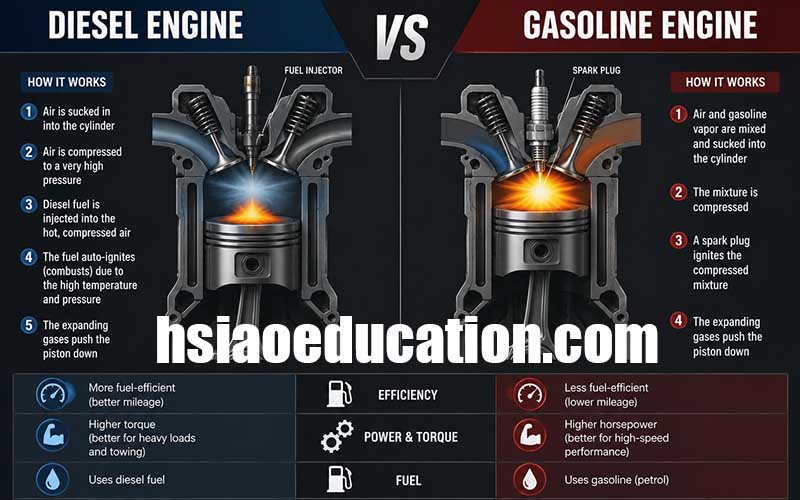
When choosing a car, one of the most important decisions is whether to buy a diesel or gasoline engine. Both types of engines have been widely used for decades, and each has its own advantages and disadvantages. Diesel engines are generally known for their fuel efficiency, strong torque, and durability, while gasoline engines are often preferred for their smoother operation, lower initial cost, and better performance at higher engine speeds. The best choice depends largely on how the car will be used, driving habits, and personal priorities.
How Diesel and Gasoline Engines Work
The main difference between the two engines is how they ignite the fuel. A gasoline engine mixes fuel with air and uses a spark plug to ignite the mixture. A diesel engine, on the other hand, compresses air to a much higher pressure, making it hot enough to ignite diesel fuel when it is injected into the cylinder. This difference in combustion technology gives the two engines their distinct characteristics.
Diesel engines typically operate at higher compression ratios and are built with stronger internal components. This contributes to their reputation for durability and makes them particularly suitable for heavy-duty applications such as trucks, vans, and long-distance vehicles.
Fuel Economy
One of the biggest advantages of diesel engines is fuel efficiency. Diesel fuel contains more energy per litre than gasoline, and diesel engines generally extract energy from the fuel efficiently. As a result, a diesel car can often travel farther on the same amount of fuel than a comparable gasoline car.
This advantage is particularly noticeable for drivers who travel long distances regularly. For example, someone who drives many kilometres on motorways or highways may benefit significantly from the lower fuel consumption of a diesel vehicle.
However, fuel economy depends on many factors, including vehicle weight, engine size, transmission, driving style, and technology. Modern gasoline engines have also become considerably more efficient, so the difference is not always as large as it was in older vehicles.
Performance and Driving Experience
Diesel and gasoline engines also feel different to drive. Diesel engines usually produce more torque at low engine speeds. This gives them strong pulling power when accelerating from low speeds, climbing hills, or carrying heavy loads. This characteristic makes diesel engines especially useful for SUVs, commercial vehicles, and towing.
Gasoline engines generally produce their power at higher engine speeds. They tend to provide smoother and quicker acceleration as the engine revs increase. Many drivers also prefer gasoline engines because they are usually quieter and smoother, particularly during cold starts and at idle.
For someone who enjoys a sporty driving experience, a gasoline engine may therefore be more appealing. For someone who values effortless low-speed power and long-distance efficiency, diesel may be the better option.
Maintenance and Reliability
Diesel engines are often associated with long service life. Their robust construction can allow them to withstand high levels of use, particularly when properly maintained. However, modern diesel engines contain complex emissions-control systems, including components such as diesel particulate filters and selective catalytic reduction systems. These systems help reduce pollution but can increase mechanical complexity and repair costs.
Gasoline engines are generally simpler, especially older naturally aspirated models. Modern gasoline engines can also contain sophisticated turbochargers, direct fuel injection, and emissions-control equipment, so they are not necessarily inexpensive to maintain.
In either case, regular maintenance is essential. Oil changes, correct fuel, proper servicing, and timely repairs can have a major effect on engine longevity.
Environmental Considerations
The environmental comparison between diesel and gasoline is complicated. Diesel engines generally produce less carbon dioxide per kilometre because they use less fuel, but diesel combustion can produce higher levels of nitrogen oxides and particulate matter if emissions are not properly controlled.
Modern diesel vehicles use sophisticated emissions systems to reduce these pollutants, while modern gasoline vehicles have also become much cleaner. The actual environmental impact therefore depends on the specific engine, emissions standard, vehicle age, and driving conditions.
Electric and hybrid vehicles have also changed the discussion considerably, giving consumers alternatives that can reduce fuel consumption and emissions even further.
Which Engine Is Better?
There is no universal winner between diesel and gasoline. Diesel is usually the better choice for drivers who cover high annual mileage, frequently drive on highways, need strong low-speed torque, or regularly tow and carry heavy loads. Its excellent fuel economy can make it attractive for long-distance driving.
Gasoline is often better for drivers who mainly make short trips, drive in urban areas, cover relatively low annual mileage, or want a quieter and smoother driving experience. Gasoline cars can also have lower purchase prices and may avoid some of the complex emissions-system issues associated with modern diesel engines.
Another important consideration is the type of driving. Diesel engines are generally most effective when they reach normal operating temperature and are driven for longer periods. Frequent short trips can be less suitable for some modern diesel vehicles because emissions-control systems such as particulate filters may not function optimally without sufficient operating conditions.
Both diesel and gasoline engines have strengths and weaknesses. Diesel engines offer excellent fuel economy, strong torque, and the potential for long service life, making them well suited to high-mileage and heavy-duty driving. Gasoline engines, meanwhile, usually provide smoother and quieter operation and can be a better choice for urban driving and shorter journeys.
Ultimately, the better engine is the one that matches the driver’s needs. If you drive tens of thousands of kilometres each year, especially on highways, a diesel may make more financial and practical sense. If you mainly drive around town and make shorter trips, gasoline is often the simpler and more suitable option. Rather than choosing based solely on the fuel type, buyers should consider purchase price, fuel consumption, maintenance costs, reliability, driving conditions, and how long they plan to keep the vehicle.